Showing posts with label Czeslaw Milosz. Show all posts

Friday, April 14, 2023

Friday Writings #72: Writing About Writing


Hello again, dear Wordsmiths!

I love to read not only all your poems and stories, but also your background notes (if any). The whole process of writing is endlessly fascinating to me.

Poems about poetry and the writing of poetry

Forty-odd years ago when I first discovered my tribe of other poets in Melbourne, and then the rest of Australia, there was a belief current among many of them that one ‘shouldn’t’ write poems about writing poetry. It was considered too inward-looking, too self-centred, not likely to speak to people in general.

And yet, many poets have done it, starting with Horace in ancient Rome, with a piece titled Ars Poetica which gave the practice its name. That means ‘the art of poetry’ but has come to be used for poems about poetry. Hands up anyone here who hasn’t done it, at least once? No-one? I thought so!

Of course the subject fascinates us – and if those poems only speak to other poets, well, these days there are a lot of us around. (And anyway, I subscribe to the view that there should be no 'shoulds' in writing poetry.)

A favourite quote from one such poem is:

… poems should be written rarely and reluctantly,
under unbearable duress and only with the hope
that good spirits, not evil ones, choose us for their instrument.

– Czeslaw Miłosz: Arts Poetica?


perhaps explained by an earlier verse in the same poem:

In the very essence of poetry there is something indecent:
a thing is brought forth which we didn't know we had in us,
so we blink our eyes, as if a tiger had sprung out
and stood in the light, lashing his tail.


Don’t you love it? Oh, I want at least some of my poems to be tigers! (Though I might want others to be flowers, or breezes, or sea-shells.)

However, I also love the more traditional view in these lines by James Elroy Flecker, from The Golden Journey to Samarkand:

We who with songs beguile your pilgrimage
And swear that Beauty lives though lilies die,
We Poets of the proud old lineage
Who sing to find your hearts, we know not why …


My very favourite piece of ars poetica, expressing a similar sentiment, is:


In My Craft or Sullen Art

By DylanThomas 


In my craft or sullen art
Exercised in the still night
When only the moon rages
And the lovers lie abed
With all their griefs in their arms
I labour by singing light
Not for ambition or bread
Or the strut and trade of charms
On the ivory stages
But for the common wages
Of their most secret heart.

Not for the proud man apart
From the raging moon I write
On these spindrift pages
Nor for the towering dead
With their nightingales and psalms
But for the lovers, their arms
Round the griefs of the ages,
Who pay no praise or wages
Nor heed my craft or art.


Another which runs that very close in my estimation is:


Necessary Explanation


By Yannis Ritsos
translated by Rae Dalven


There are certain verses—sometimes entire poems—
whose meaning even I don’t know. What I don’t know
sustains me still. And you are right to ask. Don’t ask me.
I don’t know, I tell you.
                                     Two parallel lights
from the same center. The sound of the water
falling in winter from the overflowing drainpipe
or the sound of a drop as it falls
from a rose in the watered garden
very slowly on a spring evening
like the sob of a bird. I don’t know
what this sound means; nevertheless I accept it.
Whatever else I know I explain to you. I don’t neglect it.
But these things too add to our lives. As she was sleeping
I watched her knee squaring the sheet—
It wasn’t only love. That angle
was the crest of tenderness, and the fragrance
of the sheet, the cleanness and of the springtime completed
that inexplicable thing I sought, again in vain, to explain to you.


Stories about story-telling


Let’s not entirely neglect the storytellers among us (even while acknowledging that poems can be stories too). Stories about storytelling include The Neverending Story (book and film), the Australian non-fiction study Finding Eliza by Larissa Behrendt – and the famous originator, a whole lot of separate stories within a story about story-telling: The Arabian Nights.


 If you would like a prompt this time, I invite you to write about writing: either write a poem about writing poetry, or tell us a story about story-telling.
 
Guidelines: Prompted or not, we welcome poetry or prose, old or new, one post per person, 369 words maximum. Please link, via Mister Linky, to your blog post and also follow the other links to see what the rest of us have written. Having a little chat to us, in the Comments below, is optional (but welcomed).

Have fun!

Next week, Magaly will ask us to find inspiration in the phrase “time affects all things”.


 Image of writer by Brent Gorwin on Unsplash.

Note: My favourites have lasted over the years. Some of you may recall the poems quoted above from our old days as Poets United – but I thought such wonderful lines could bear repeating.

Friday, February 25, 2022

Friday Writings #15: "After" Another

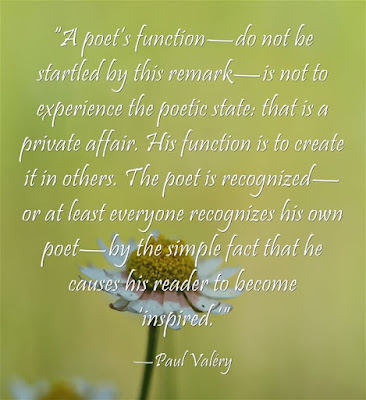
This month I'm doing NaHaiWriMo (writing the shortest genre of poetry every day during the shortest month). The admin of the facebook group, Michael Dylan Welch, recently posted this, which feeds nicely into my theme for this week's prompt:


I’m sure we’ve all seen, and perhaps wondered about, poems with the subtitle ‘After [name of another poet]’.  Google explains:

When you write a poem heavily influenced by another poem you always acknowledge it with the word ‘after’ and the original poet’s name.


One also sometimes sees, ‘After Reading [name of a specific poem or book] by [poet’s name].' This seems to be when the new poem is a response to the original but not so ‘heavily influenced’ – or when the material read is not just one particular poem.

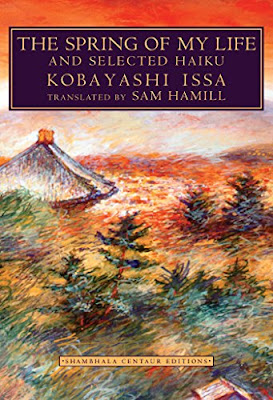
A recent email in poets.org's poem-a-day series showed me this delightful piece by Dobby Gibson: After Reading Kobayashi Issa’s The Spring of My Life on My 49th Birthday. It’s quite short; do have a quick look

In this case The Spring of My Life is a whole book. 


In the poets.org series, poets are also asked to record an ‘About This Poem’. Gibson says of his:

After a snowstorm, there’s a stillness that hints at a grace we can’t quite access. It becomes possible to imagine the unburdening of the self. Hence my debt here to Issa, and also to Milosz’s poem written after Issa, who wrote his haibun after Basho’s. Which is to say that poems, like birthdays, are intensely serial. I’ll never know all the voices speaking through me. 

(The mention of Basho’s haibun also refers to a whole book, his famous The Narrow Road to the Deep North.)

I love both Basho and Issa, and also greatly admire Czeslaw Milosz, so it was no hardship to me to read the Milosz poem and grab the Issa book. (I already had Basho’s.) Dobby Gibson, whom I hadn’t encountered before, seems worth exploring further too.

I also love the idea of poems being ‘intensely serial’ and that we’ll never know all the voices speaking through us – especially true if you were brought up on poetry from an early age, as I was lucky enough to be.

If you would like to try a prompt this week, I invite you to re-read a favourite piece of writing, which may be poetry or prose, allow yourself to be inspired by it and share the results with us. We would also like to know, please, ‘after’ whom, or ‘after reading’ what – even if you are working in prose. (You may tell us in a subtitle or a note.)

OR:

Free choice: You don’t have to write to a prompt; only to share with us whatever you would like to – old or new, prose or verse.

Our only rules are one post per person, and that prose pieces must be within 369 words, excluding title.

The prompt will stay open all week. Link to your post, below, and don’t forget to come back to find those treasures linked later in the week.

Enjoy!


For our next Friday Writings, Magaly will invite us to spend  a few moments considering the word "Peace"... then write poetry or prose inspired by the thoughts that come to mind.


Friday, July 24, 2020

Wild Fridays #29: The Living Dead

Winter
– Czeslaw Milosz (1911-2004)

The pungent smells of a California winter,
Grayness and rosiness, an almost transparent full moon.
I add logs to the fire, I drink and I ponder.

“In Ilawa,” the news item said, “at age 70
Died Aleksander Rymkiewicz, poet.”

He was the youngest in our group. I patronized him slightly,
Just as I patronized others for their inferior minds
Though they had many virtues I couldn’t touch.

And so I am here, approaching the end
Of the century and of my life. Proud of my strength
Yet embarrassed by the clearness of the view.

Avant-gardes mixed with blood.
The ashes of inconceivable arts.
An omnium-gatherum of chaos.

I passed judgment on that. Though marked myself.
This hasn’t been the age for the righteous and the decent.
I know what it means to beget monsters
And to recognize in them myself.

You, moon, You, Aleksander, fire of cedar logs. 

Waters close over us, a name lasts but an instant. 
Not important whether the generations hold us in memory. 
Great was that chase with the hounds for the unattainable meaning of the world. 

And now I am ready to keep running 
When the sun rises beyond the borderlands of death. 

I already see mountain ridges in the heavenly forest 
Where, beyond every essence, a new essence waits. 

You, music of my late years, I am called 
By a sound and a color which are more and more perfect. 

Do not die out, fire. Enter my dreams, love. 
Be young forever, seasons of the earth.


From Selected and Last Poems 1931-2004. Selected by Robert Haas and Anthony Milosz, translated by Anthony Milosz. USA, HarperCollins (Ecco) 2006; UK, Penguin Classics, 2014.

 
I'm in the middle of reading this book at present, a recent purchase.  It's a wonderfully full volume in both length and content. These poems deserve some pondering (to use his own word). Seamus Heaney, another great 20th Century poet, says in his foreword, 'From start to finish, merciless analytic power coexisted with helpless sensuous relish.'

Milosz witnessed and survived German Naziism and the early days of Russian Communism. And he lived long enough to be aware of humanity's environmental destructiveness. Some of his poems are understandably bleak (despite his strong Catholic faith). Others, however, display that 'sensuous relish' Heaney mentions. I chose this one partly because it is so positive and so visionary, partly because of what it suggests about being a poet.


Wikipedia tells us: 
 
Czeslaw Milosz ... was a Polish-American poet, prose writer, translator, and diplomat. Regarded as one of the great poets of the 20th century, he won the 1980 Nobel Prize in Literature. In its citation, the Swedish Academy called Miłosz a writer who "voices man's exposed condition in a world of severe conflicts".
Miłosz survived the German occupation of Warsaw during World War II and became a cultural attaché for the Polish government during the postwar period. When communist authorities threatened his safety, he defected to France and ultimately chose exile in the United States, where he became a professor at the University of California, Berkeley. His poetry—particularly about his wartime experience—and his appraisal of Stalinism in a prose book, The Captive Mind, brought him renown as a leading émigré artist and intellectual.
Throughout his life and work, Miłosz tackled questions of morality, politics, history, and faith. As a translator, he introduced Western works to a Polish audience, and as a scholar and editor, he championed a greater awareness of Slavic literature in the West. Faith played a role in his work as he explored his Catholicism and personal experience.
Miłosz died in Kraków, Poland, in 2004. He is interred in Skałka, a church known in Poland as a place of honor for distinguished Poles.

The article expands to a lot more detail about his life and work. If you'd like the extra information, click this link.

Meanwhile here is Jane Hirshfield reading the poem, after which she gives a very interesting analysis of it. Yes, I know we all hated the way poems were pulled apart at school. This is on a different level, being for adult students, and is done with great respect and love for the poem as well as deep understanding.


Material shared in 'The Living Dead' is presented for study and review. Poems, photos and other writings and images remain the property of the copyright owners, where applicable (older poems may be out of copyright).

This photo of Czeslaw Milosz is by Artur Pawlowski, made available under Creative Commons licence CC BY-SA 4.0